
Your pressure canning times change with altitude because atmospheric pressure drops as you go higher, which lowers water's boiling point. At sea level, water boils at 212°F (100°C), but at 2,000 feet it drops to 208°F, making it harder to kill harmful bacteria like Clostridium botulinum. You'll need to either increase your processing time or raise the pressure to compensate for this effect. For every 2,000 feet above sea level, you must add 1 pound of pressure when using a dial-gauge canner. Understanding these altitude adjustments will help guarantee your preserved foods stay safe and bacteria-free.
The Science Behind Altitude Effects
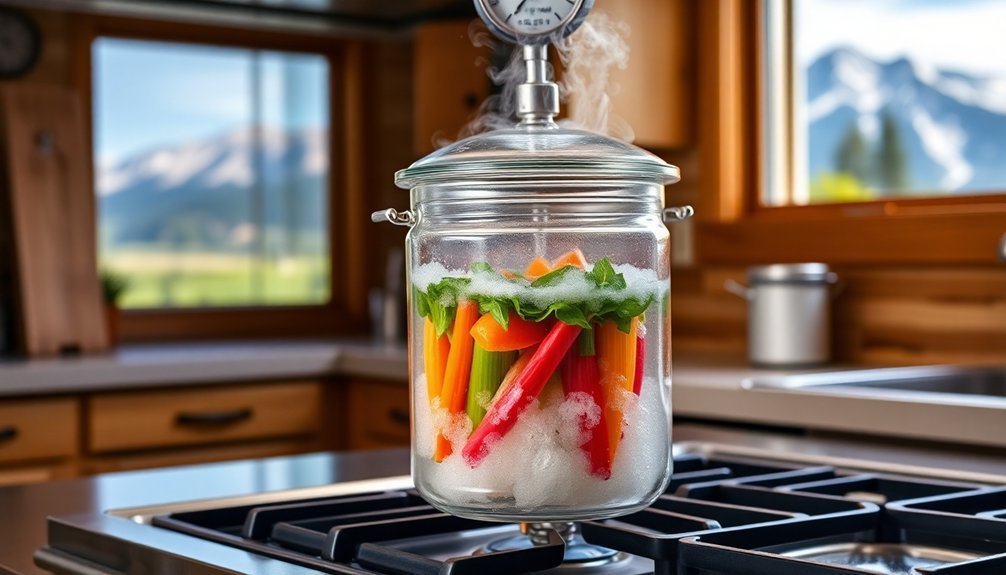
Every home canner needs to understand how altitude affects the safety of their preserved foods. When you're canning at higher elevations, you're dealing with a fundamental principle of physics: atmospheric pressure decreases as you go up in altitude. This happens because gravity's pull on air molecules is stronger near Earth's surface, creating denser air and higher pressure at lower altitudes. The standard atmospheric pressure at sea level is significantly higher, with readings of 1013.25 millibars.
At higher elevations, you'll find that air molecules are less compressed and have less weight pushing down on them. This reduction in atmospheric pressure directly impacts your canning process by lowering the temperature at which water boils. Since you need to reach specific temperatures to kill harmful bacteria and spores (typically 240°F), you'll need to compensate for this pressure difference.
You won't notice much difference at elevations under 1,000 feet, but above that, you'll need to make important adjustments. The physics behind this means that for every 2,000 feet you climb, you must increase your pressure by 1 pound in dial-gauge canners.
If you're using a weighted-gauge canner, you'll need to use the 15-pound weight once you're above 1,000 feet.
Understanding Boiling Point Changes
Working with canning at different altitudes requires a clear understanding of how boiling points change with elevation. You'll find that as you move to higher altitudes, water boils at progressively lower temperatures due to decreased air pressure.
At sea level, water boils at 212°F (100°C), but if you're canning on Mount Everest, you'd see water boil at just 160°F (71°C). The kinetic energy required for water molecules to reach boiling point decreases significantly at higher elevations.
These lower boiling points directly impact your food preservation efforts. When you're canning at higher elevations, the water's reduced temperature won't be as effective at killing bacteria, which means you'll need to adjust your processing times.
For example, if you're following a recipe designed for sea level, you'll need to increase your processing time by 5-20 minutes, depending on your altitude.
You'll notice this effect most dramatically when using a boiling water bath for canning. The water simply can't reach the temperatures needed for safe food preservation without pressure assistance.
That's why pressure canning becomes increasingly important at higher altitudes – it's the only way to achieve the necessary temperature for safe food preservation through mechanical pressure adjustment.
Pressure Canning at Sea Level
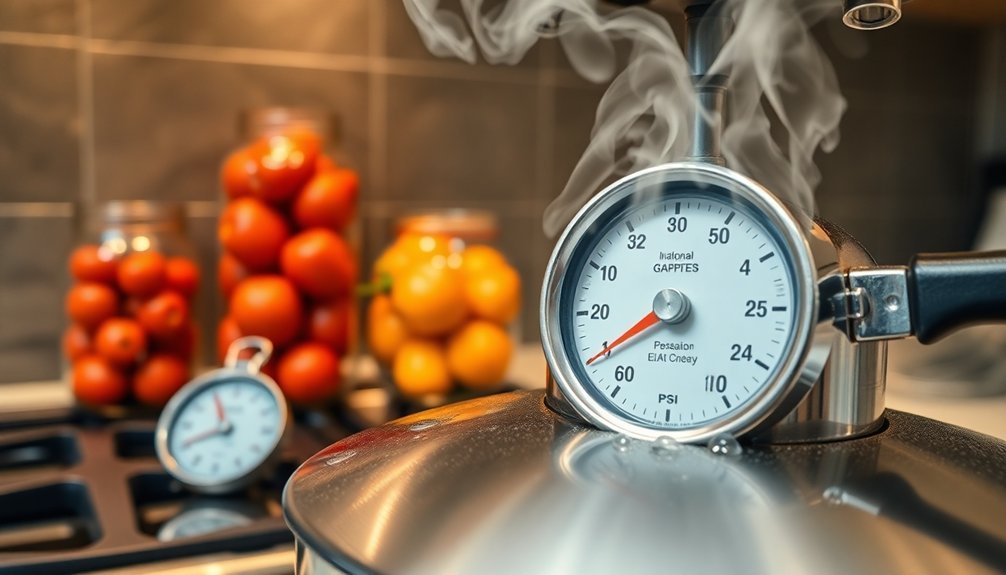
Safety in pressure canning starts with understanding sea-level processing guidelines. At sea level to 1,000 feet elevation, you'll need to maintain 10-15 pounds of pressure, depending on what you're canning. Your pressure canner must reach temperatures up to 240°F (115°C) at 10 psi to effectively kill harmful bacteria and spores, particularly Clostridium botulinum.
When you're pressure canning at sea level, you'll find that processing times typically range from 20 to 90 minutes. Proper processing is crucial since Clostridium botulinum thrives in the oxygen-free environment of sealed canning jars. You'll need to monitor your pressure gauge consistently and never leave your canner unattended during processing. It's essential to let the canner vent properly before starting the processing time.
| Aspect | Requirement | Purpose |
|---|---|---|
| Pressure | 10-15 psi | Kill harmful bacteria |
| Temperature | Up to 240°F | guarantee sterilization |
| Processing Time | 20-90 minutes | Complete preservation |
Your canner type matters – you can use either a weighted-gauge or dial-gauge model. Whichever you choose, make sure to maintain it properly and check it regularly for accuracy. Remember to follow tested recipes precisely and allow your canner to cool naturally after processing to guarantee proper sterilization.
High Altitude Canning Challenges
When you're canning at high altitudes, you'll face a critical challenge: water boils at lower temperatures, which means it won't get hot enough to kill harmful bacteria effectively.
You'll need to increase your processing time in water bath canning and adjust pressure levels in pressure canning to compensate for these lower temperatures.
At 1,000 feet elevation, for example, you'll need to add 5 minutes to water bath processing times and increase pressure by 1 pound for every 2,000 feet above sea level when using a dial-gauge pressure canner.
Lower Boiling Points
If you're canning at high altitudes, you'll need to account for a critical scientific principle: water boils at lower temperatures as elevation increases. While water boils at 212°F (100°C) at sea level, you'll find this temperature drops significantly as you climb higher, affecting both your canning process and food safety.
This temperature reduction directly impacts how you'll need to adjust your canning methods. You'll need longer processing times in water bath canning, and pressure canning requires specific adjustments to achieve safe preservation temperatures.
| Altitude (ft) | Water Boiling Point | Required Adjustments |
|---|---|---|
| 0-1,000 | 212°F (100°C) | Standard recipes |
| 1,001-3,000 | 210°F (99°C) | Increase time 5-10% |
| 3,001-5,000 | 208°F (98°C) | Increase time 15% |
| Above 5,000 | Below 208°F (98°C) | Add pressure/extend time |
The lower boiling point also affects gel formation in jams and jellies. You can't rely solely on candy thermometers above 1,000 feet; instead, you'll need to use the sheet test for accurate results. Remember to leave additional headspace in your jars, as steam expands more at higher altitudes.
Pressure Compensation Methods
Building on our understanding of lower boiling points at high altitudes, proper pressure adjustments become the key to successful pressure canning.
You'll need to increase your canner's pressure by 1 psi for every 2,000 feet of elevation to reach the required 240°F (116°C) processing temperature.
Your canner type will determine how precisely you can make these adjustments. If you're using a dial gauge canner, you can fine-tune the pressure in small increments, making it easier to achieve exact settings.
With weighted gauge canners, you're limited to 5-pound increments, which means you'll typically use the 15-pound weight for altitudes above 1,000 feet.
To determine your correct pressure setting, first check your exact altitude using Google Maps or local extension service resources. If you're below 1,000 feet, 10 psi is usually sufficient. Above that elevation, you'll need at least 15 psi.
Remember, while pressure requirements change with altitude, your processing time stays the same once you've reached the correct pressure.
Always follow your canner manufacturer's specific guidelines, as different models may have unique requirements for altitude adjustments.
Measuring Altitude for Safe Canning
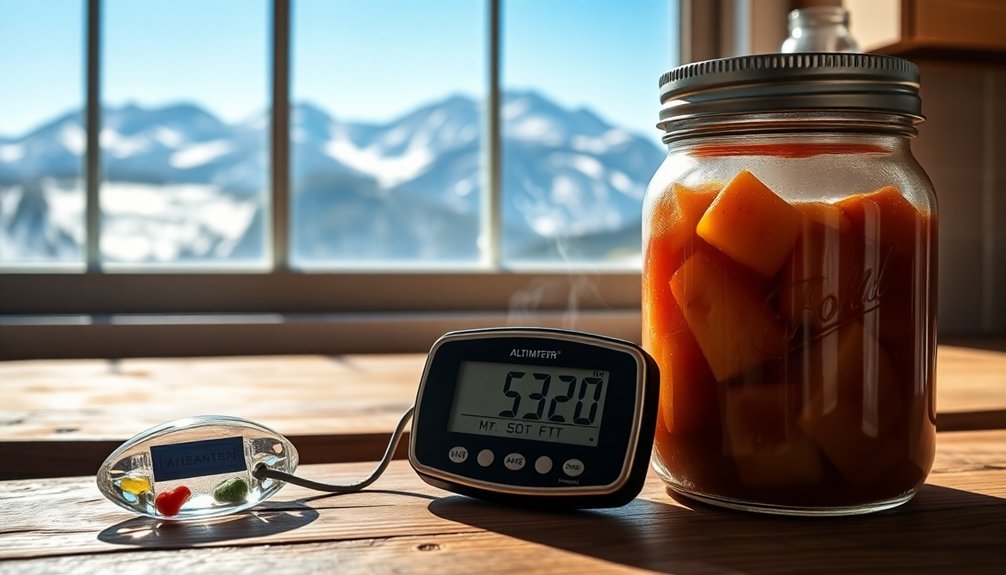
In accordance with safe canning practices, determining your exact altitude is an important first step before beginning any home canning project. Since altitude affects water's boiling point, you'll need to make essential adjustments to guarantee your food is safely processed.
As you climb higher, water boils at lower temperatures – dropping from 212°F at sea level to as low as 200°F at high elevations, which can greatly impact your food's safety.
You've got several reliable ways to find your exact altitude:
- Check your local zoning office or town website for official elevation data
- Use Google Maps by entering your address and finding the elevation
- Download an altimeter app or visit the "What is my elevation?" website
- Contact your local County Extension office for precise information
Don't skip this important step – incorrect altitude measurements can lead to underprocessed food and dangerous foodborne illnesses like botulism.
Dial Gauge Pressure Adjustments
Your dial gauge pressure must be adjusted incrementally based on your altitude, starting at 11 pounds for 0-1,000 feet and increasing by one pound for each subsequent 2,000-foot range.
You'll need to test your dial gauge annually for accuracy and replace it if readings are off by more than 2 pounds.
When reading your gauge during processing, verify you're at eye level with the dial and maintain the recommended pressure throughout the entire processing time.
Incremental Pressure Per Altitude
Adjusting your pressure canner's dial gauge for altitude doesn't need to be complicated. For every 1,000 feet above sea level, you'll need to add 0.5 pounds of pressure to guarantee safe food preservation. This incremental approach allows you to make precise adjustments that account for the lower boiling point of water at higher elevations.
- At 1,000-3,000 feet: Add 0.5 pounds to your base pressure requirement
- At 3,001-6,000 feet: Add 1 pound to your base pressure requirement
- At 6,001-8,000 feet: Add 1.5 pounds to your base pressure requirement
- At 8,001-10,000 feet: Add 2 pounds to your base pressure requirement
Your dial gauge canner offers more flexibility than weighted gauges because you can make these small, precise adjustments.
For example, if you're at 3,000 feet and your recipe calls for 10 pounds of pressure at sea level, you'll set your dial gauge to 11 pounds instead of jumping to 15 pounds as you'd need to with a weighted gauge.
While your processing times won't change with altitude, these pressure adjustments are essential for reaching the proper temperature to kill harmful bacteria like Clostridium botulinum.
Basic Gauge Safety Tips
Because maintaining accurate dial gauges is essential for safe pressure canning, you'll need to focus on several key safety measures. If your gauge readings are off by more than 2 pounds at 11 pounds of pressure, you should have it tested at your county extension office or through the manufacturer. Inaccurate gauges can lead to dangerous underprocessing or wasteful overprocessing of your food.
| Safety Aspect | What to Check | Action Required |
|---|---|---|
| Gauge Reading | Accuracy | Test if off by >2 lbs at 11 lbs |
| Lid Care | Moisture | Don't immerse or tip upside down |
| Sealing | Gaskets & Rings | Replace if worn or hardened |
| Steam Leaks | Lid & Kettle | Apply cooking oil to edges |
| Safety Parts | Fuses & Plugs | Replace if damaged |
You'll need to handle your gauge carefully to maintain its accuracy. If adjustments are needed, you can correct zero shift by removing the cover and resetting the needle. For span shift, you'll need to connect to a known pressure source and adjust accordingly. Remember to clean your gaskets regularly and watch for steam leaks that might require additional water during processing.
Proper Gauge Reading Methods
Learning how to read a dial gauge accurately can make the difference between safe and unsafe pressure canning. You'll need to verify your gauge provides precise readings by having it tested annually, even if it's new and unused.
When monitoring your gauge during processing, pay close attention to the numbered scale and adjust your burner heat accordingly to maintain the correct pressure.
For accurate pressure readings at your altitude, remember these critical steps:
- Calculate your altitude adjustment by adding 0.5 pounds of pressure for every 1,000 feet above sea level.
- Monitor your dial gauge continuously throughout the entire processing time.
- Check that your gauge reading matches the tester gauge within 2 pounds during annual testing.
- Adjust your heat source promptly when pressure fluctuates.
If you notice any inconsistencies in your gauge readings or have trouble maintaining steady pressure, don't continue processing. Instead, have your gauge tested at your local cooperative extension office.
Remember that incorrect readings can lead to under-processing or over-processing, potentially compromising your food's safety. Your dial gauge's accuracy directly affects the temperature inside your canner, making proper reading essential for safe food preservation.
Weighted Gauge Canning Methods
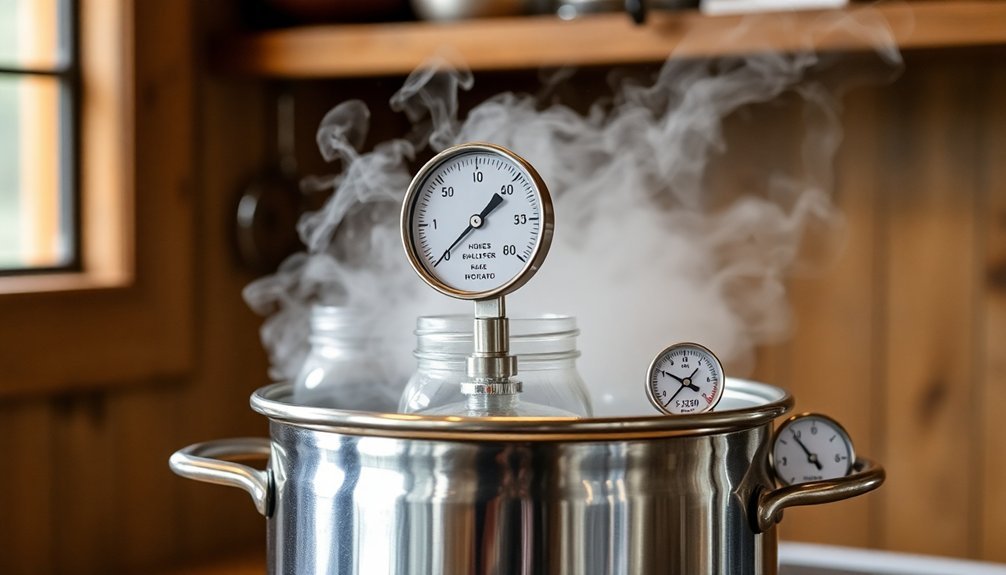
Home canners who use weighted gauge pressure canners rely on a simple yet effective mechanism for controlling pressure. The gauge fits over the air vent tube and regulates pressure by releasing excess steam when it rocks or jiggles, letting you know your canner's maintaining the right pressure without constant monitoring.
If you're canning at altitudes above 1,000 feet, you'll need to adjust your pressure settings. While your processing times won't change, you must increase pressure to compensate for lower atmospheric pressure at higher elevations. You'll need to use 10 psi instead of 5 psi, or 15 psi instead of 10 psi, as weighted gauges only adjust in 5-pound increments.
When you're using your weighted gauge canner, you'll start timing once the weight begins to rock steadily. You should reduce heat to maintain the recommended movement, preventing excessive steam release.
The 3-piece pressure regulator lets you maintain different pressures on compatible canners. While weighted gauges aren't as precise as dial gauges for altitude adjustments, they're easier to use since they don't require constant checking and automatically maintain the selected pressure.
Food Safety at Higher Elevations
Safe food preservation at higher elevations requires careful attention to the relationship between altitude and temperature. As you move to higher elevations, the atmospheric pressure drops, causing water to boil at lower temperatures. This means that without proper adjustments, your canned foods mightn't reach the temperatures needed to kill harmful bacteria, particularly Clostridium botulinum.
- At 2,000 feet, water boils at 208°F instead of 212°F, requiring you to increase your processing time by 5 minutes.
- You'll need to add 2 PSIG of pressure between 1,001-3,000 feet to maintain safe preservation temperatures.
- Between 3,001-6,000 feet, you must add 10 minutes to water bath processing times.
- For every 1,000 feet above sea level, you'll experience approximately a 1°F drop in water's boiling point.
To guarantee food safety, you'll need to adjust both your processing times for water bath canning and pressure levels for pressure canning.
Don't rely on sea-level instructions if you're at a higher elevation. Check your specific altitude using tools like Google Maps and follow USDA guidelines for precise adjustments.
Time Versus Pressure Considerations
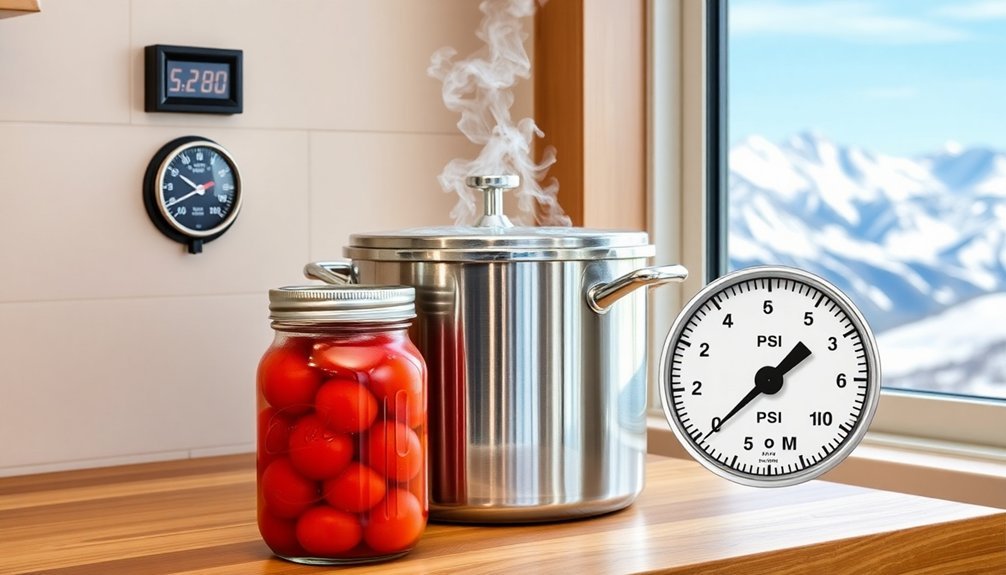
Understanding altitude adjustments in pressure canning requires distinguishing between two key variables: processing time and pressure levels.
When you're pressure canning at higher altitudes, you'll need to adjust the pressure, but not the processing time. This differs notably from boiling water canning, where you must increase processing times at higher elevations.
For your pressure canner, you'll need to increase the pressure by 1 pound for every 2,000 feet above sea level if you're using a dial-gauge model. If you have a weighted-gauge canner, you'll simply use the 15-pound weight when you're above 1,000 feet.
The increased pressure guarantees your food reaches the critical temperature of 240°F (116°C) needed to kill harmful bacteria.
You won't need to adjust your processing times because the higher pressure compensates for the lower boiling point at elevation. This makes pressure canning more straightforward than boiling water canning, where you'd need to add 5 minutes for altitudes of 1,001-3,000 feet and 10 minutes for 3,001-6,000 feet.
Remember to check your specific altitude through local resources to guarantee you're using the correct pressure settings.
Bacterial Growth and Altitude
Bacterial growth presents unique challenges when canning at higher altitudes due to the lower atmospheric pressure. As you move to higher elevations, water's boiling point decreases, which means you'll need to make specific adjustments to guarantee harmful bacteria, particularly Clostridium botulinum, are eliminated from your canned foods.
Your pressure canner needs to achieve higher pressures at altitude to reach the vital temperature of 240°F (115°C) necessary for killing bacteria. Without proper adjustments, you're risking underprocessed food that could harbor dangerous bacterial growth.
- At 1,001-3,000 feet, increase your pressure by 2 psig
- At 3,001-5,000 feet, increase your pressure by 3 psig
- At 5,001-7,000 feet, increase your pressure by 4 psig
- Above 7,000 feet, increase your pressure by 5 psig
You'll need to follow these USDA-approved guidelines strictly to guarantee your canned foods are safe for consumption.
The relationship between altitude and bacterial survival isn't something you can ignore – proper pressure adjustments are essential for achieving the sterilization temperatures needed to destroy harmful bacteria and their spores.
Mountain Region Canning Guidelines
Mountain regions pose distinct challenges for home canners, requiring careful attention to altitude-specific guidelines. If you're canning at elevations above 1,000 feet, you'll need to make specific pressure adjustments to guarantee your food preserves safely. For every 2,000-foot increase in elevation, you must add approximately 1 pound of pressure to your dial gauge canner.
In mountain regions, you'll find that water boils at lower temperatures – as low as 208°F at 2,000 feet compared to 212°F at sea level. To compensate for this difference, you'll need to increase your canner's pressure. For example, if you're at 3,500 feet, you'll need to process your food at 13 psig instead of the standard 10 psig used at sea level.
While the processing time stays the same, the increased pressure guarantees that your food reaches the temperature necessary to kill harmful bacteria.
If you're using a weighted gauge canner in mountain regions, you'll need to use the 15-pound weight for all altitudes above 1,000 feet, as these canners don't allow for incremental adjustments like dial gauge models do.
Testing Your Pressure Canner
Your dial gauge pressure canner needs annual testing to guarantee it's within 2 pounds of the correct pressure reading.
You'll want to contact your local Extension office, which often provides free testing services using a calibrated master gauge.
While weighted gauge canners don't require annual testing, dial gauge models must be tested before each canning season to prevent potentially dangerous food preservation errors.
Checking Your Gauge Accuracy
Testing pressure canner gauges stands as one of the most critical safety measures in home food preservation. Your gauge's accuracy directly impacts food safety, as even a small error in pressure readings can greatly decrease sterilization effectiveness.
A 1-pound error reduces sterilizing value by 10%, while a 2-pound error causes a 30% decrease, potentially leading to dangerous foodborne illnesses like botulism.
If you're using a dial gauge pressure canner, here's what you need to know:
- Get your gauge tested annually at your local extension office – they often provide this service for free.
- Bring either the gauge alone or the entire lid if the gauge can't be removed.
- If your gauge reads more than 2 pounds off, you'll need to replace it immediately.
- For dual-gauge canners, you can rely on the weighted gauge and ignore the dial gauge.
You don't need to test weighted gauges as they're consistently accurate and indicate proper pressure through a distinctive jiggling sound.
When using a dial gauge that's accurate within 2 pounds, adjust your processing pressure according to the test results to guarantee safe preservation.
Required Testing Methods
Proper testing procedures guarantee your pressure canner operates safely and effectively.
You'll need to visit your local Extension office, where trained personnel can test your dial gauge using a master gauge testing unit. Most offices, including Henrico and MSU Extension locations, offer this service free of charge.
During testing, you'll bring your canner lid with the dial gauge attached. The testing process involves comparing your gauge's readings to a calibrated master gauge using a specialized unit with a foot pump and plastic cylinder.
Even if your gauge can't be removed from the lid, testing can still be performed. The testing unit's vent pipe and rubber seal maintain consistent pressure for accurate measurements.
You must test dial gauge canners annually, but weighted gauge canners don't require testing since they use a weight system that produces a distinctive "jiggle" sound.
If your gauge reads within 2 pounds of the master gauge, you can continue using it by adjusting your processing pressure accordingly. However, if it's off by more than 2 pounds, you'll need to replace it before your next canning session.
Frequently Asked Questions
Can I Use the Same Canning Recipes From My Grandmother at Different Altitudes?
You'll need to adjust your grandmother's canning recipes based on your current altitude. While you can use her recipes, you must modify processing times and pressure levels to guarantee food safety at your location.
Should Pressure Canner Gaskets Be Replaced More Frequently at Higher Elevations?
You don't need to replace pressure canner gaskets more frequently at high elevations. Just follow the standard 2-3 year replacement schedule and watch for signs of wear like hardening, stickiness, or poor sealing.
How Does Altitude Affect the Shelf Life of Pressure-Canned Foods?
If you properly adjust your pressure canner for altitude, your food's shelf life won't be affected. However, if you don't increase pressure at higher elevations, incomplete sterilization can reduce shelf life and safety.
Do Different Types of Foods Require Different Altitude Adjustments?
Yes, you'll need different adjustments based on your food type. High-acid foods require longer water bath times at altitude, while low-acid foods need increased pressure settings but maintain the same processing duration.
Can I Pressure Can During Stormy Weather at High Altitudes?
You shouldn't pressure can during stormy weather at high altitudes. The combination of electrical risks and altitude-related pressure challenges makes it unsafe. Wait for clear weather to guarantee proper pressure control and safety.
In Summary
You'll need to adjust your canning times at higher altitudes because water boils at lower temperatures the higher you go. This affects your canner's ability to reach safe processing temperatures for killing harmful bacteria. By extending your processing time or increasing pressure, you're compensating for this scientific reality. Always check your local extension office's altitude-specific guidelines to guarantee your food preservation is safe.